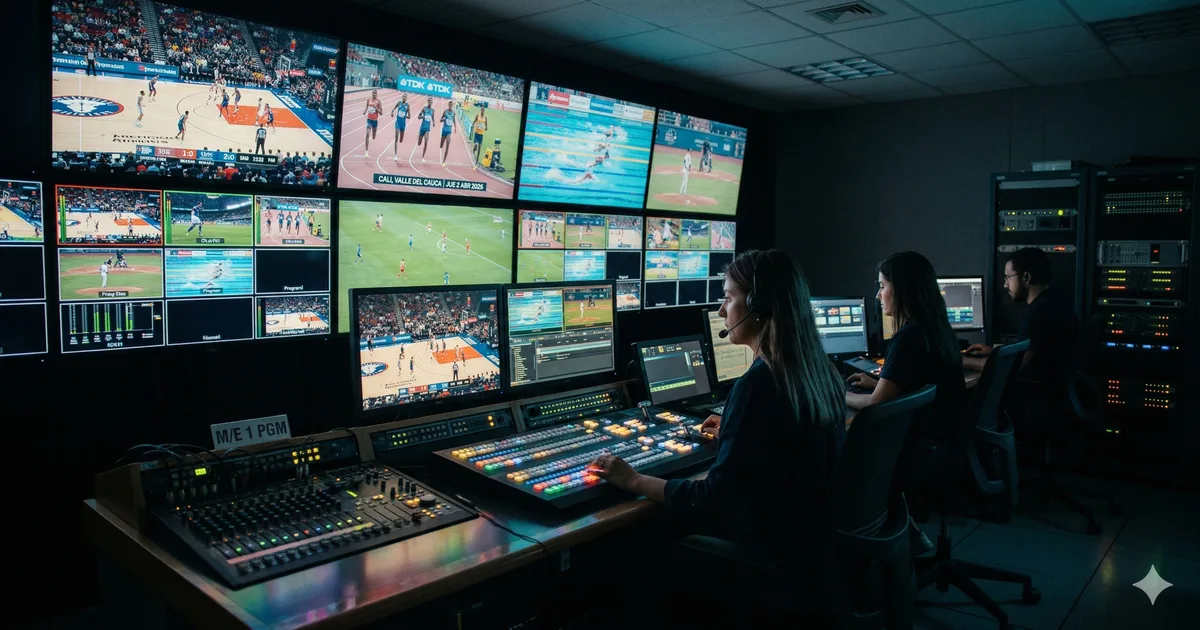
Multi-sport production: lessons from covering 12 sports simultaneously
Twelve sports. Twelve simultaneous sessions. One central system. This is the reality of covering Multi-sport Games with a lean production team.
The first lesson you learn is that scaling isn’t just about adding operators. It’s about designing a system that works equally well with one or twenty sports active at the same time.
The classic mistake: the monolithic system
Most broadcast graphics systems are designed for one sport at a time. One console, one output, one operator. When you try to adapt them for multi-sport production, problems appear immediately: How do you separate the athletics scorebug state from swimming? How do you prevent one operator from accidentally overwriting another sport’s score?
Independent sessions as the solution
The correct architecture for multi-sport production is: one session per sport, completely independent from the others. Each session has its own communication channel, its own persisted state, its own output URL for OBS or vMix, and its own specialized console.
The sessions panel: the director’s view
In an event with multiple active sports, the production director needs a central view showing which sessions are active, who’s operating them and if there are any issues. A grid of active sports with status indicators (live, paused, finished) is the most useful coordination tool.
Operator assignment
In large events, assignment is by specialty: the most experienced operators cover the sports with the most technical complexity or highest viewership. One operator can cover two simultaneous sports if the games don’t overlap in their most active moments.
Unified vs. per-sport visual identity
The correct answer for most events is: same base visual identity (colors, fonts, event logo), but a different console per sport. The athletics scorebug and the swimming scorebug look the same in design, but work differently in logic.
Critical moments
In multi-sport production, the most demanding moments are simultaneous starts. Pre-event checklist per session:
- Event data loaded (teams, athletes, schedules)
- Data integration active and verified
- IN and OUT templates tested
- Operator assigned and confirmed access
- OBS/vMix with Browser Source configured and verified
Communication between operators
A communication channel between all operators during the event is as important as the technical system. A group chat or voice channel is the difference between resolving a problem in thirty seconds and having it reach the air.