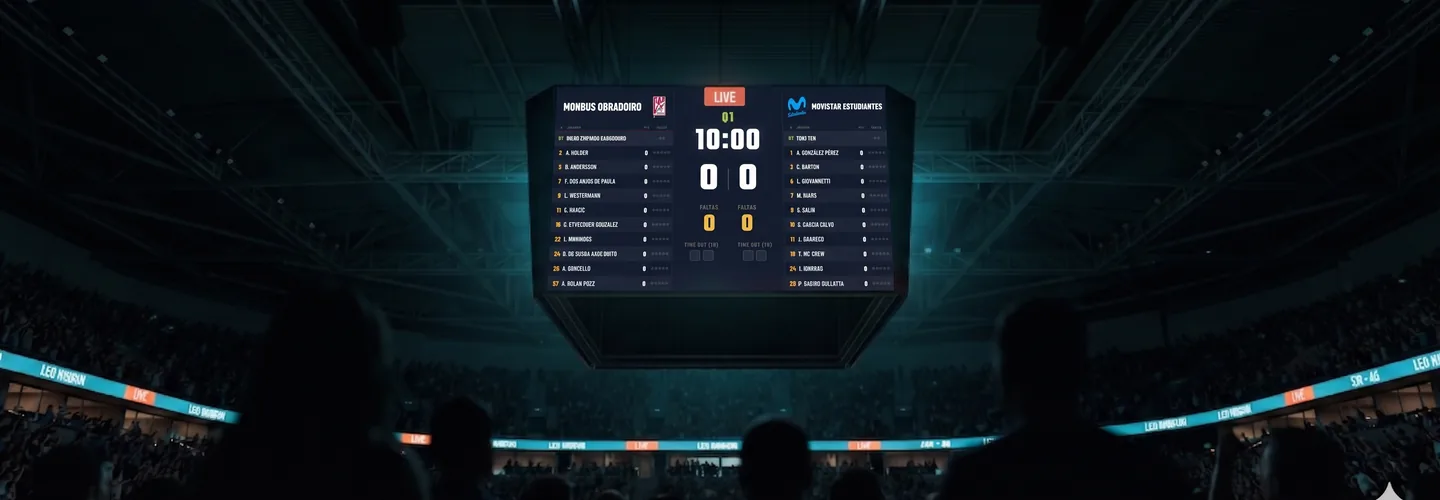
The in-venue audience watches the LED screen. The TV viewer watches the scorebug overlay. Traditionally these are two separate systems, two operators, two cables. KronoGraph Arena unifies them: a single source of truth feeds both the LED and the broadcast simultaneously, via a dedicated /arena/{shortCode} mode that renders the scoreboard on opaque background for the venue's screen.
Who this service is for
- Arenas and stadiums with installed LED screens needing to modernize scoreboard control without changing the LED or processor.
- Federations running events at different venues each round — the LED is venue-owned, KronoGraph plugs in as source.
- Production companies already running the broadcast bundle wanting to add the stadium LED without contracting another vendor.
- One-off events (finals, all-stars, exhibitions) arriving at an LED-equipped venue needing turnkey operation.
How it differs from the broadcast bundle
Opaque vs transparent output
The broadcast bundle renders a 1920×1080 transparent page that OBS or vMix capture as Browser Source. KronoGraph Arena renders the scoreboard on opaque background (black or project color), built for the physical LED screen where there's no underlying layer: what you see is what goes to the LED.
Layout designed for distance
Stadium LED graphics are read from 30-50 meters away. Larger typography, higher contrast, bold numbers and saturated colors. KronoGraph Arena has a differentiated layout optimized for that reading distance — not just the broadcast template scaled up.
Dedicated URL per LED
Each LED in the venue gets its own URL: /arena/{shortCode} for the main LED, /arena/{shortCode}?layout=ribbon for the perimeter ribbon. Each layout has its own resolution and composition.
Shared state with broadcast
They share the same state via Supabase Realtime and BroadcastChannel. When the operator scores a point on the panel, the change appears simultaneously on the stadium LED and the broadcast overlay — zero desync between in-venue and TV.
LED processor compatibility
The output is a web page at the LED's resolution. Any modern LED processor (Novastar, Colorlight, Brompton, Megapixel) accepting HDMI or SDI can capture the browser as a source. The machine running Chrome connects to the processor with a standard HDMI cable — no proprietary plugins, no dedicated hardware, no extra licenses.
Real production use cases
- DPB Colombia arena — the venue's main LED operated with the same bundle as the TV broadcast, perfect sync.
- FEB pavilions in Spain — the venue's local scoreboard plugs into the broadcast operation via the same console.
- FIBA qualifying events — itinerant venues with venue-owned LEDs, KronoGraph as single-source-of-truth.
- All-Star events — special productions with perimeter ribbon LEDs, custom layouts per LED.
What's included
- Dedicated Arena mode (/arena/{shortCode}) with opaque output optimized for LED
- Differentiated layouts (main LED, perimeter ribbon, video wall) — each with its own URL
- Real-time shared state with the broadcast bundle (Supabase Realtime + BroadcastChannel)
- Compatible with any LED processor via HDMI/SDI (Novastar, Colorlight, Brompton, Megapixel)
- Resolutions from 1280×720 up to 4K, custom aspect ratios (cylindrical LEDs, ribbons)
- Typography and contrast optimized for 30-50m reading distance
- Project brand kit auto-reskins the LED
- Operated from the same broadcast console — single operator for both
- No proprietary plugins, no dedicated hardware, no extra licenses
Frequently asked questions
How does it differ from the broadcast bundle?
Broadcast is transparent overlay for OBS/vMix. Arena is opaque scoreboard for the stadium LED. They share backend and data.
Does it work with any LED brand?
Yes. Any modern processor (Novastar, Colorlight, Brompton, Megapixel) accepting HDMI/SDI captures Chrome as source.
Synced with broadcast?
Yes. Same state via Supabase Realtime. Zero lag between LED and TV.
Supports non-standard LEDs?
Yes. Any resolution up to 4K. Cylindrical LEDs or ribbons get a specific template.
Who operates the LED?
The same broadcast operator (or a dedicated one for big events). Same console, different output URL.