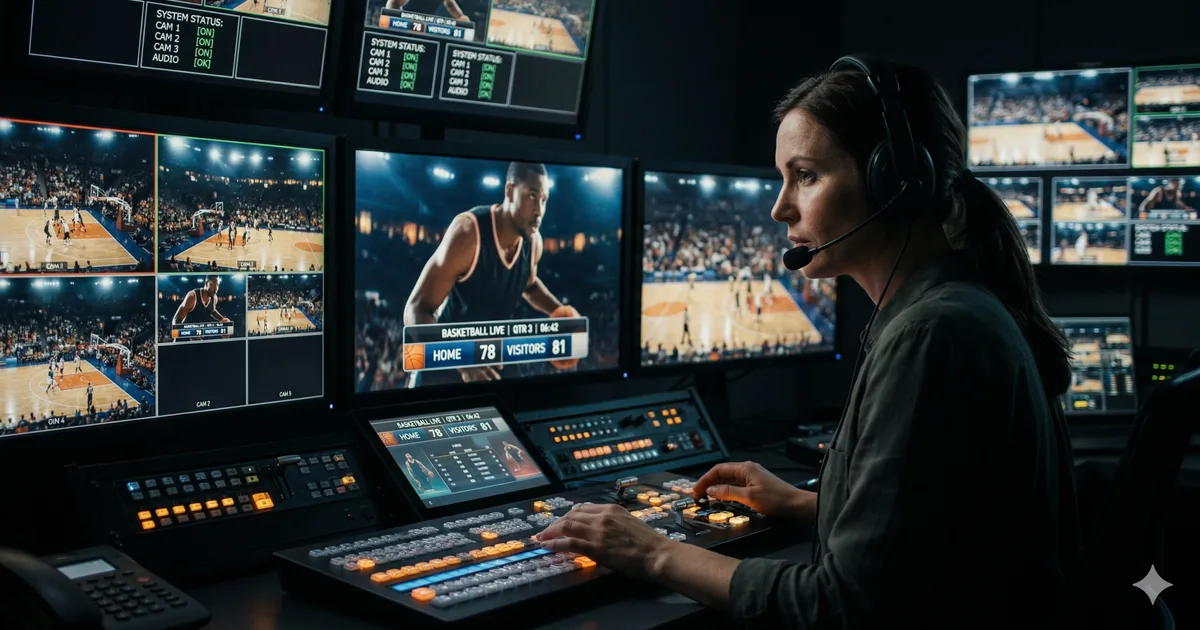
How to operate a scorebug live without errors during 40 minutes of play
The broadcast graphics operator is the most invisible professional in a sports production. When doing it right, nobody notices. When making a mistake, everyone sees it.
Forty minutes of live play, with no real pause, the game changing every three seconds. This is the reality of operating a professional scorebug in basketball.
The trap of the operator who updates manually
The most common mistake is not technical — it’s about focus. When the operator has to manually update the score, fouls, clock and possession at the same time, attention is split between the control screen and the actual game. That’s where errors happen.
Data integration as a real advantage
The fundamental shift in modern professional operation is delegating data updates to automatic systems.
Official sports API: The most reliable source. Genius Sports transmits every play, score change, foul and statistic in real time for FIBA competitions. The operator doesn’t touch the scoreboard — only monitors.
Web integration: For tournaments without an official API, many competitions publish real-time scores on their official website. An integration bridge reads that information and feeds it to the graphics system.
OCR — screen reading: When there’s no API or updated web source, the system can read the score directly from the video signal. The most flexible option, though it requires initial calibration.
Game console: In some sports, the game control table transmits data directly. Integrating that console eliminates double data entry.
Google Sheets: For smaller productions, Google Sheets with real-time updates is a surprisingly effective solution.
What the operator does when data arrives automatically
When the operator doesn’t have to update the scoreboard, they can focus on telling the story of the game. Who’s the leading scorer so far? How many fouls does the starting point guard have? Those are the graphics that elevate a production from correct to excellent.
The pre-game routine
- Verify the data integration is active and receiving correct information
- Load game data — teams, players, referees
- Test every template with IN and OUT
- Confirm with the production director which graphics go on air and when
- Have emergency presets ready — suspension messages, overtime
During the game
The scorebug stays on from tip-off to the final buzzer. The operator monitors that data is arriving correctly and intervenes manually only when there’s a discrepancy with the official score.
The most costly mistake
Leaving the scorebug with the wrong score on screen while the game progresses. If integration fails or there’s incorrect data, the operator must detect it within ten seconds and correct it manually. The key is always having both the official arena scoreboard and the on-screen scorebug in view.